Introduction
AI is not confined only to the labs and major technology firms anymore. Currently, businesses belonging to different verticals have started implementing AI to help them make decisions, automate tasks, better their customers’ experience and to tackle difficult business situations. This means that firms want to hire individuals who can work on AI-related projects.
As for those who wish to earn a Computer Science Degree or have already obtained a bachelor’s in Computer science, there are promising career prospects because of the increasing demand for people with AI skills. However, a common question for those graduates is what kind of skills will be in the greatest demand from future employers. In fact, studying all the topics associated with AI is unrealistic.
The following article will investigate AI skills that computer science graduates should acquire to enhance their career perspectives.
Why AI Skills Matter for Computer Science Graduates
A good Computer Science degree will equip you with basic knowledge of programming, algorithms, software engineering, and problem solving. This is knowledge that will be very relevant for years to come.
Yet, more and more companies require that computer science graduates possess both computer science skills and AI skills. Companies need people who not only have programming skills but also know how to create intelligent programs which will learn from data and help in making business decisions.
For graduates with a BS in CS, gaining AI skills can open doors to a wider range of opportunities while making them more adaptable to changing industry needs.
10 Essential AI Skills to Learn
1. Machine Learning Fundamentals
Machine Learning remains one of the most important areas within AI.
The graduates need to be able to comprehend machine learning and how to create predictive systems. Understanding the theory of supervised, unsupervised learning and model validation will help develop a strong base for advanced uses of AI.
Knowledge of Machine Learning will be useful in communicating with AI teams as well.
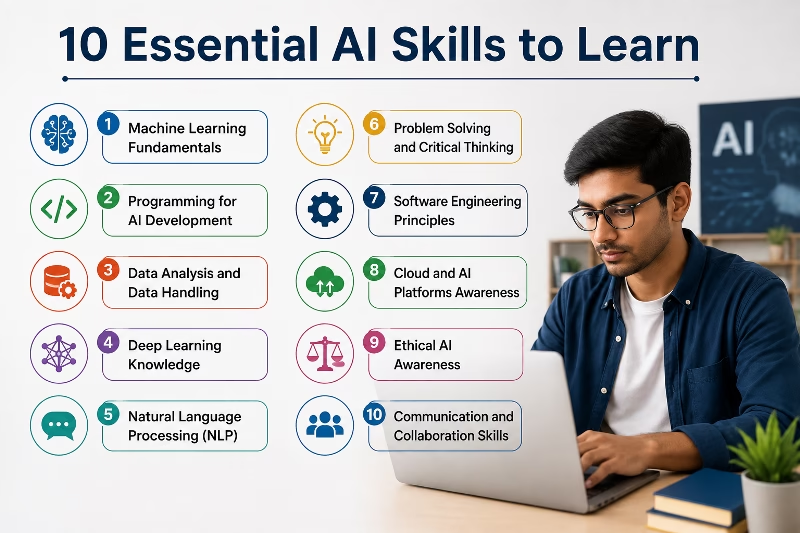
2. Programming for AI Development
Programming continues to be a critical skill for AI careers.
The future graduates of computer science must improve their coding skills and understand how code is used in data analysis, automation and the creation of models for AI. The companies need specialists who can write the code effectively and efficiently.
It will be much simpler to develop AI solutions for the problems of customers when having strong coding skills.
3. Data Analysis and Data Handling
AI systems depend heavily on data.
It is very important that future AI professionals learn how to collect, process, clean, and analyze data. The quality of the data will influence the effectiveness of AI algorithms, hence the importance of such skills.
Those graduates who have knowledge about data flows will be better prepared to solve real-world business problems.
4. Deep Learning Knowledge
Deep Learning has become an important component of modern AI applications.
A variety of sophisticated systems used for image recognition, natural language processing, and recommendation engines use deep learning algorithms. It is unnecessary for graduates to master this technology straight away but knowing the basics will undoubtedly help to build their knowledge about AI.
The more candidates know about these technologies, the better it is valued by employers.
5. Natural Language Processing
Natural Language Processing involves the study of machines comprehending and generating natural human language.
Natural Language Processing has become popular due to the increasing use of AI-based communication systems by organizations for their daily tasks.
Students graduating in Computer Science can play an important role in improving customer interaction through their knowledge of AI language systems.
6. Problem Solving and Critical Thinking
AI is not merely about technology. AI is also about problem-solving.
It is important for organizations to hire individuals who have the capability to analyse their problems and figure out if there are appropriate uses of AI that could solve their problems and how to evaluate possible solutions to these problems.
One of the most transferable skills in the field of technology is problem-solving.
7. Software Engineering Principles
Many graduates focus exclusively on AI while overlooking software engineering fundamentals.
The truth is that companies require people who know how to implement AI technology within software systems. Skills in software engineering, testing, implementation, and maintenance are still very relevant.
A graduate who is knowledgeable in software engineering and AI is very valuable.
8. Cloud and AI Platforms Awareness
Many AI applications operate through cloud-based environments.
Knowing how cloud technology aids in developing AI an important asset in the job market since employers is will always value people who know how to implement AI solutions in their actual business settings.
Knowledge in this field will enable graduates to get involved in enterprise-level projects.
9. Ethical AI Awareness
As AI becomes more influential, ethical considerations are becoming increasingly important.
Professionals should understand responsible AI development, ethics, fairness, and issues of privacy. The ability to develop AI in a responsible manner shows professionalism.
Knowledge about ethical AI is gaining importance as a distinction when it comes to joining the field.
10. Communication and Collaboration Skills
Technical expertise alone is often not enough.
The professionals working in the field of artificial intelligence normally work with the management team, product teams, analysts, and other stakeholders from different departments. It can be considered an important ability to communicate with people from different backgrounds.
Students having technical as well as communication skills usually advance faster in their careers.
How Graduates Can Prepare for AI Careers
For students pursuing a Computer science degree or recent graduates with a BS in CS, developing AI skills should be approached strategically.
Some practical focus areas include:
- Building strong programming foundations
- Learning Machine Learning concepts
- Understanding data analysis techniques
- Exploring Natural Language Processing
- Studying Deep Learning fundamentals
- Strengthening software engineering knowledge
- Developing problem solving abilities
- Improving communication and teamwork skills
- Learning responsible AI practices
- Staying informed about industry developments
The goal should not be to master every AI specialization immediately. Instead, graduates should focus on building a balanced skill set that combines technical expertise with practical application.
What Employers Are Looking For
Hiring managers increasingly seek candidates who can adapt, learn quickly, and contribute to evolving technology environments.
They often value:
- Strong computer science fundamentals
- AI and Machine Learning awareness
- Practical project experience
- Analytical thinking
- Collaboration skills
- Business understanding
- Continuous learning mindset
Graduates who demonstrate these qualities often position themselves well for opportunities in AI related roles.
Conclusion
Artificial Intelligence is still revolutionizing industries while opening exciting job opportunities for technology professionals. Although a degree in Computer science is a good starting point, employers now look for additional artificial intelligence skills among the graduates.
For those pursuing a bachelor’s degree in computer science, proficiency in such skills as Machine Learning, data analysis, Natural Language Processing, software engineering, ethics of AI, and problem-solving can greatly boost their job chances. Another crucial factor is communication and teamwork skills.
The best graduates will be those who have a combination of good fundamentals and the ability to learn and change. It is possible to ensure that computer science graduates will be prepared for their careers by developing the appropriate AI skills now.
Frequently Asked Questions
What are the most important AI skills for Computer Science graduates?
Important areas include Machine Learning, programming, data analysis, Deep Learning, Natural Language Processing, problem-solving, software engineering, cloud awareness, responsible AI, and communication.
Do Computer Science graduates need to learn Machine Learning?
Machine Learning is an important area of AI and can be a useful skill for graduates interested in AI-related careers. Beginners can start with fundamental concepts before moving toward advanced topics.
Is programming necessary for learning AI?
Programming is an important part of many AI applications. It is used for data processing, automation, model development, and integrating AI capabilities into software.
Should students learn Deep Learning immediately?
Not necessarily. Students can first develop programming, data, and Machine Learning fundamentals before progressing to more advanced Deep Learning concepts.
Why is data analysis important for AI?
AI systems often depend on data. Understanding how data is collected, cleaned, processed, and analyzed can help graduates understand how AI applications produce useful results.
Are communication skills important for AI careers?
Yes. AI projects often involve multiple teams and stakeholders, so the ability to communicate technical ideas and collaborate effectively can complement technical expertise.